Jeep 3.6L Pentastar engines commuting along MN-15 face severe volumetric efficiency losses due to suspended road construction silica. Particulate saturation creates an intake pressure drop exceeding 25 inches of water, forcing the ECM to command +15% fuel trim corrections. This mechanical restriction destroys fuel economy and induces destructive electrical heat-soak in HVAC blower motors.
Highway 15 Detour Silt Turns Paper Intake Media Into a Solid Wall
Jeeps commuting the MN-15 corridor between Mound and Shorewood operate in a concentrated zone of pulverized asphalt and heavy machinery dust. When standard paper intake pleats absorb this fine medical-grade and road-base silica, the media seals over completely.
To understand the speed of this restriction, consider a Jeep Gladiator we brought onto the lift at our Spring Park shop after it spent three months daily-commuting through the Navarre road widening project. Forensic pressure testing confirmed an intake restriction that had choked the engine long before the OEM 30,000-mile service interval. In the reality of West Metro summer road construction, a standard paper filter frequently reaches absolute saturation at 6,000 miles.
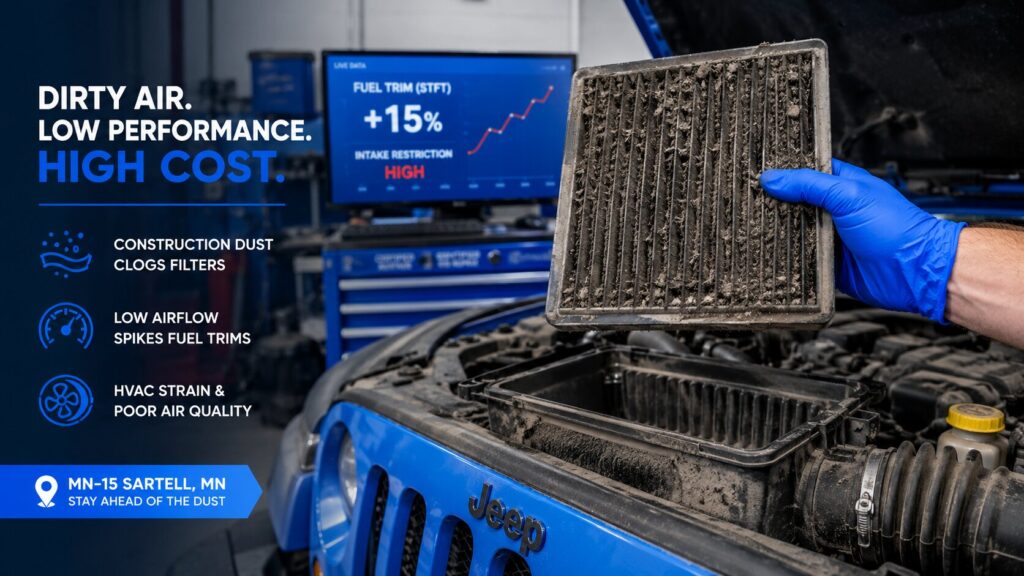
When Intake Vacuum Hits 25 Inches of Water, Fuel Trims Spike +15%
The 3.6L Pentastar is a high-volume breathing engine. As a Jeep accelerates out of the detour stops near County Road 15, the engine attempts to pull air through a clogged filter barrier, generating a massive vacuum spike inside the intake tube.
Live diagnostic scanning under these conditions reveals Short-Term Fuel Trims (STFT) immediately shifting +15% into the positive. Because the Engine Control Module (ECM) reads the high manifold vacuum as a lack of fuel density, it commands the injectors to dump raw gasoline into the cylinders to prevent a lean misfire. This pumping loss is the exact physical mechanism that destroys highway gas mileage and creates a noticeable throttle lag when merging into stop-and-go traffic near Shoreline Drive.
Why Does May Rain Turn Construction Dust Into Cabin Filter Crust
The combination of airborne silica and the Lake Minnetonka area’s heavy spring humidity creates a non-permeable layer of sludge across cabin air filter media. This moisture-rich environment traps alkaline concrete dust in the pleats, forming a damp, cement-like crust that never truly dries.
Indicators of severe cabin ventilation restriction:
- A persistent, sharp acrid smell of damp mildew immediately upon AC startup
- Maximum fan speed settings producing less than 50% of normal vent velocity
- An audible, high-pitched mechanical whine radiating from behind the glovebox
- Rapid interior windshield fogging during high-humidity lakeside morning drives
Blower Motor Parasitic Current Draw Physics
The consequences of a sealed cabin filter extend beyond poor air quality; they threaten the climate control wiring infrastructure. When a blower motor attempts to push air through a solid wall of trapped river-valley silt, static pressure inside the HVAC plenum skyrockets.
When our technicians back-probe the electrical connector under the dash, we routinely see this restriction forcing the motor to draw an extra 4.5 Amps of continuous current just to maintain fan rotation. This localized heat-soak degrades the blower motor resistor pack. Operating a Jeep in a high-resistance electrical state for the duration of a daily MN-15 commute frequently melts the plastic harness pins directly into the resistor terminal.
Gray Silica Grime and Manifold Absolute Pressure Skewing
Suspended construction dust is fine enough to bypass economy aftermarket air filters entirely. Once inside the intake plenum, this micro-silt coats the Manifold Absolute Pressure (MAP) sensor element in a layer of insulating gray grime.
This contamination insulates the thermistor, skewing intake air temperature and barometric pressure data sent to the computer. The ECM assumes the engine is operating in a completely different atmospheric zip code, altering ignition timing and causing a hunting, unstable idle when sitting at the Spring Park bayside traffic lights.
How Do Shop Technicians Pinpoint an Induction Pressure Drop
True automotive breathing certification requires measuring live sensor data against ambient barometric pressures outside the shop bay. Utilizing a digital manometer pinpoints the exact physical drop across the induction system without relying on guesswork.
We resolve this construction-induced starvation by stripping and chemically cleaning the contaminated MAP sensor element, resetting the long-term adaptive fuel memory, and installing a high-depth synthetic media filter capable of holding particulate mass without collapsing the intake tract.
MN-15 daily commuters noticing sluggish throttle response or AC blower whine can have their induction pressure drops and fuel trims verified at Certified Auto Repair, 4700 Shoreline Drive, Spring Park, MN 55384.
Frequently Asked Questions
Does construction dust on MN-15 really affect my Jeep’s fuel economy?
Yes. Suspended silica dust from local road reconstruction creates an extreme particulate load on the intake filter. This induces severe engine pumping losses and triggers ECM fuel trim adjustments, resulting in a documented drop of 2 to 4 miles per gallon.
Why does my Jeep AC smell like damp socks on humid mornings?
Trapped organic crust. Heavy spring lake humidity binds with airborne concrete and asphalt dust trapped inside your cabin filter. This creates a wet, alkaline crust that serves as a breeding ground for mildew and mold spores inside the dark HVAC housing.
Can a dirty air filter actually cause my Jeep engine to stall?
Yes. Severe filter restriction creates erratic airflow dynamics that confuse engine management sensors. If the MAP sensor becomes coated in un-filtered silica silt, the ECM cannot calculate air density accurately, leading to surging idles or stalling at traffic lights.
How often should I change my air filter if I commute on MN-15?
Every 5,000 to 7,500 miles. While OEM manuals suggest 30,000-mile replacement intervals, operating a vehicle in a high-silica road construction zone accelerates media loading. Standard filters consistently hit maximum pressure restriction long before factory service benchmarks.