High-velocity vertical impacts from spring potholes exceed the elastic limits of Jeep rubber bushings, causing internal tearing and caster misalignment. These strikes often bend steering linkages by a mere 2mm, triggering electronic stability control errors. Additionally, road salt infiltrates strut seals, causing hydraulic failure and nitrogen loss.
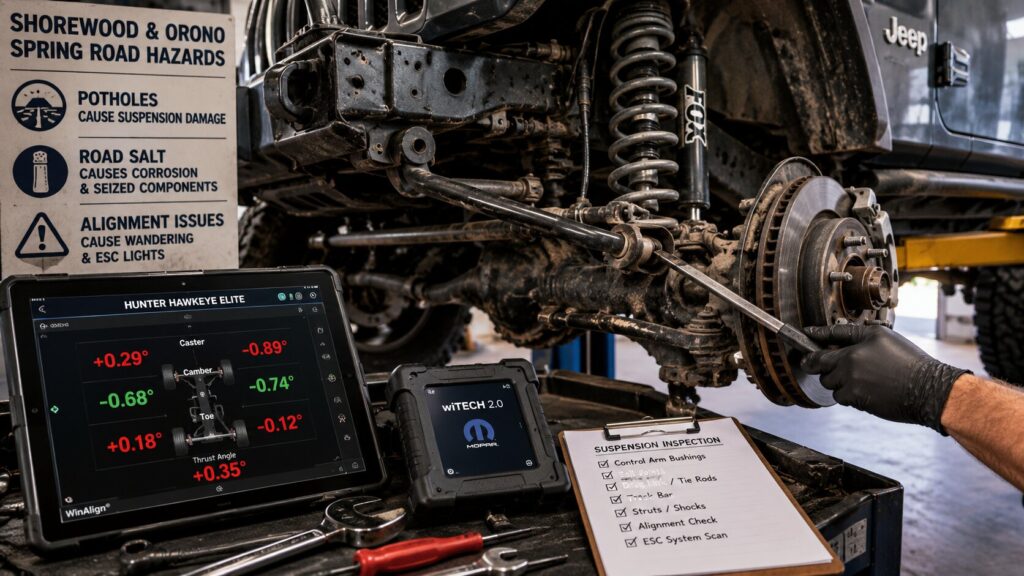
Inspecting Jeep Control Arm Bushings for Hidden Damage
When we get a Wrangler on the lift and wedge a pry bar against the front lower control arm, the visual appearance of the bushing is often deceptive. The factory service manual suggests simply looking for cracks, but the second we apply physical leverage, you can watch the inner steel sleeve slide completely away from its rubber housing. This elastomeric failure proves the rubber has delaminated internally after a high-speed strike.
Why Your Jeep Wanders or Feels Unstable on the Highway
When these bushings tear, the axle housing rotates. Even a fraction of an inch of movement creates a caster shift exceeding 0.5 degrees. This is why the vehicle feels nervous. It wants to hunt and wander because the self-centering physics of the front end are gone. The owner might think the tie rods are straight, but no amount of toe adjustment fixes a torn control arm bushing.
Road Salt Damage in Ball Joints and Steering Components
We often see ball joint sockets that have developed a flat spot. If the wheel stays turned after completing a corner, the customer is experiencing memory steer. This happens because heavier 35-inch tires increase the unsprung weight. When the vehicle hits a deep crater, that extra mass hammers the ball into the socket with enough force to deform the metal.
To check for this, our technicians grab the wheel at the twelve and six o’clock positions and shake. During this physical inspection, we are looking for three specific signs of salt damage:
- A dry-socket groan: The sound of metal on metal indicating road salt has turned the joint grease into a gritty paste.
- White salt bloom: Visible crust encasing the threads of the drag link.
- Seized adjustment sleeves: Steel sleeves that have become galvanically bonded to the aluminum knuckles.
When these components are seized, standard alignment is impossible. We must use an induction heater to break the bond; otherwise, pulling harder will simply snap the bolt.
Electronic Power Steering Problems After a Pothole Strike
When we plug in the scanner, the dashboard often shows a Service Electronic Stability Control message. This is not a computer glitch. Checking the live data for the Steering Angle Sensor, we frequently see 3 degrees of input to the right, even though the Jeep is sitting perfectly straight on our Hunter Hawkeye Elite rack.
Why the Traction Control Light Appears After Suspension Damage
When a pothole strike bends the drag link by even 2mm, it triggers a chain reaction of electronic faults:
- The tiny physical bend forces the steering wheel slightly off-center.
- The Electronic Power Steering (EPS) computer detects steering torque from the driver trying to keep the vehicle straight.
- The computer registers zero lateral G-force, creating a logic conflict.
- The system assumes the Jeep is in an uncontrollable slide and immediately disables the traction systems as a safety precaution.
Advanced Suspension Diagnostics After a Pothole Strike
We analyze the PicoScope waveform of a pogo-stick oscillation. A front driver-side strut with a wet body indicates the hydraulic oil has escaped. Road salt from the March melt acted like sandpaper on the strut shaft. When the suspension bottomed out, that grit shredded the oil seal. The nitrogen charge is gone, and this Jeep is riding entirely on its coil springs now.
Alignment Data Reveals Hidden Steering and Suspension Damage
The smoking gun is the 800-millisecond lag in suspension settling after a bump. We torque the new track bar bolts to the 125 Lb-Ft spec. A simple visual inspection would have missed the internal bushing tear and the sensor drift. I use the alignment data to prove exactly where the metal failed.
Get a Complete Jeep Suspension Inspection After a Pothole Strike
Understanding the physics behind spring pothole damage is the first step, but only expert diagnostics can reveal the hidden damage like elastomeric failure, hydraulic loss, and sensor drift. If your Jeep is suffering from wandering, memory steer, or an inexplicable service light, get the definitive answers and precision repairs you need.
Visit the Certified Auto Repair specialists at 4700 Shoreline Drive Spring Park, MN 55384.
Frequently Asked Questions
Can a pothole cause my Jeep to pull to one side?
Yes, a pothole can cause your Jeep to pull to one side because a high-velocity impact often bends the steering linkage or tears the rubber control arm bushings. Uneven suspension angles cause pulling because the Jeep moves toward the side with less caster or more negative camber.
Does road salt affect Jeep suspension components?
Yes, liquid calcium chloride used in the spring penetrates the seals of ball joints and tie rod ends. This chemical accelerates galvanic corrosion, turning grease into abrasive paste and seizing adjustment sleeves, which makes performing a standard alignment nearly impossible without using induction heat to break the rust.
Why is my traction control light on after hitting a pothole?
Your traction control light comes on after hitting a pothole because the impact can bend a steering component like the drag link. This physical bend moves the steering wheel off-center, creating a calibration mismatch in the Steering Angle Sensor, causing the computer to perceive a slide and disable traction systems.
How do technicians find hidden suspension damage?
Technicians identify hidden damage by performing functional stress tests with pry bars to detect internal bushing delamination. While visual checks might miss small fractures, using a Hunter Hawkeye Elite alignment rack or PicoScope reveals hydraulic dampening failures and sensor drift that are invisible to the naked eye.
Can potholes damage Jeep struts and shocks?
Yes, hitting a deep pothole can force road grit past the strut oil seals, causing a loss of nitrogen charge. This results in a wet shock body and hydraulic failure. Without proper dampening, the Jeep will bounce excessively on the coil springs, leading to poor handling.
What is the specific torque spec for Jeep track bar bolts?
The factory torque specification for Jeep JL and JT track bar bolts is 125 Lb-Ft. Ensuring this exact tightness is critical after a pothole strike, as loose hardware leads to death wobble. Technicians must always verify these specs during a post-impact suspension inspection to ensure safety.