Jeep brakes need heat to work right. In high-traffic school zones like Mound Westonka, those short, low-speed taps never let the rotors hit the 300°C needed to properly burnish the pads. This results in cold-spot glazing, surface crystallization, and premature pad depletion during stop-and-go morning commutes.
When these Jeeps roll into the shop smelling like burnt brakes, we know exactly what happened. The manual says 12,000 miles, but stop-and-go humidity kills these pads by 6,000.
Troubleshooting Squealing Jeep Brakes in Stop-and-Go Traffic
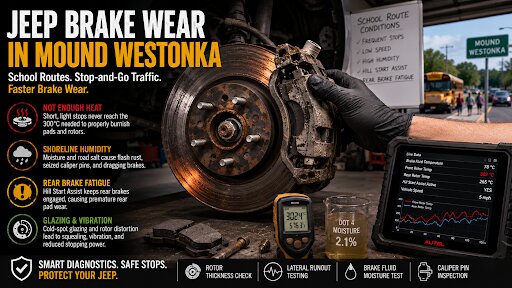
Rhythmic wheel chirping indicates a failed bedding process. Jeep braking systems need consistent heat to deposit a microscopic boundary layer on the rotor. However, a short school commute fails to generate the necessary 300°C required for this adhesive friction phase.
The Problem with Short Commutes
Without reaching the proper temperature, pads operate in an abrasive mode that grinds directly into the rotor iron. Cold-spot glazing vitrifies the pad into a glass-like state, destroying friction and preventing thermal equilibrium. By the time vehicles reach their destination, the brakes perform at a fraction of their intended efficiency.
Identifying Caliper Hardware Failures Caused by Shoreline Humidity
Aggressive Shoreline humidity effectively welds caliper hardware together overnight. When metallic brake dust mixes with ambient moisture and road salt, it creates a highly corrosive paste. This mixture accelerates the seizing of caliper sliding pins through rapid flash rust.
Diagnostic indicators for this specific moisture failure include:
- A noticeable dragging sensation while driving because the brake pads cannot retract correctly.
- Rapid accumulation of flash rust on the sliding caliper guide pins.
- Total failure of the caliper to center itself over the rotor structure.
Resolving Flash Rust and Seized Sliding Pins on Jeep Brake Calipers
Moisture from the lake air creates a high-friction environment for the sliding pins. Seized pins force the inboard pad against the rotor even after releasing the brake pedal. This causes localized overheating and transmits a gritty vibration through the steering wheel.
Furthermore, abrasive road sand from winter treatments often lingers in the knuckles. This debris becomes trapped between the pad and the rotor surface. The resulting friction carves deep grooves that compromise the structural integrity of the metal.
Analyzing Premature Rear Brake Pad Depletion Due to Vehicle Assist Systems
On the rolling terrain, rear brake depletion is a major issue. Computers in the JL Wrangler and WL Grand Cherokee constantly engage the rear calipers using Hill Start Assist. While the system stops roll-back on gradients, stop-and-go school lines transform it into a primary source of wear.
How Hill Start Assist Creates Rear-Load Brake Fatigue During Idling
While idling on an incline, the Jeep computer maintains hydraulic pressure on the rear calipers. During repeated creeping and stopping, the rear pads are always the last components to release. This constant dragging combines with prolonged engine idling to create severe rear-load fatigue.
Rear rotors on these specific platforms have a remarkably thin discard thickness. They often allow for only two millimeters of total wear before requiring replacement. Consequently, rear pads frequently deplete down to the metal backing plates by 8,000 miles in these environments.
Precision Diagnostic Protocols for Safe Stopping Power
Here is how we track down the issue in the bay. Shoreline humidity turns brake fluid into a sponge, lowering its boiling point once moisture hits a critical threshold. To make sure the vehicle is safe, we check two specific things: component distortion and hydraulic metrics.
- Use a digital micrometer to measure rotor thickness across multiple distinct points.
- Check lateral rotor runout to a thousandth of an inch precision, ensuring it does not exceed the tight 0.003-inch tolerance.
- Inspect for harmonic distortions that manifest directly as a pulsating pedal during a stop.
- Test fluid contamination using a professional DOT 4 fluid tester to identify when copper or moisture hits a two percent threshold.
Professional inspection is essential to maintain safety and prevent the failure of Jeep braking systems in this environment. Do not wait for warning lights or a spongy pedal to appear; specialized moisture and runout inspection is the crucial step. Schedule your Certified Auto Repair brake safety inspection today at our local facility: 4700 Shoreline Drive Spring Park, MN 55384
Frequently Asked Questions
Do Jeep brakes feel spongy after idling in the school drop-off line?
Yes. Jeep brakes feel spongy after idling because extended idling starves the system of vacuum assist. This forces a shift in pedal resistance that manifests as a soft, spongy feel.
Can Shoreline humidity actually damage a Jeep braking system?
Yes. Shoreline humidity damages a Jeep braking system by accelerating the oxidation of caliper sliding pins and rotor surfaces. Flash rust forces the brake pads to stick or drag. This causes localized overheating that warps rotors and severely diminishes stopping power.
Why are rear Jeep brake pads wearing out before the front ones?
Rear Jeep brake pads wear out before the front ones because Hill Start Assist and electronic brake distribution constantly engage the rear calipers on inclines. In rolling terrain, this logic causes increased rear pad friction and faster depletion.
How often should Jeep brakes be inspected for school-run driving?
Jeep brakes for school-run driving should be inspected every 6,000 miles. This shorter interval allows technicians to accurately measure rotor runout. It also provides an opportunity to clean late-season road debris before it scores the braking surfaces.
What is the acrid scent coming from the wheels after a short commute?
The acrid scent coming from the wheels results from outgassing when brake pads reach high temperatures without adequate cooling. Short driving cycles force the braking system to sustain a constant load. This ultimately cooks the pad resin until the structural integrity of the compound fails.
Why does a steering wheel shake when braking near pedestrian crossings?
A steering wheel shakes when braking because of lateral runout or rotor warping. Repeated heat soaking from school-zone traffic can distort the metal. The pads then bounce off the uneven surface, transmitting a harsh shudder through the steering wheel.