Freezing Lake Minnetonka temperatures spike battery resistance and trigger severe performance failures in hybrid vehicles. Critical system breakdowns often occur within the high-voltage heating loop alongside salt-induced isolation faults, frequently throwing code P1E04. Specialized high-voltage testing and control module data analysis are required to distinguish between standard vehicle self-protection and physical component failure.
Technical Reason Cars Suspend Electric Driving in Freezing Temperatures
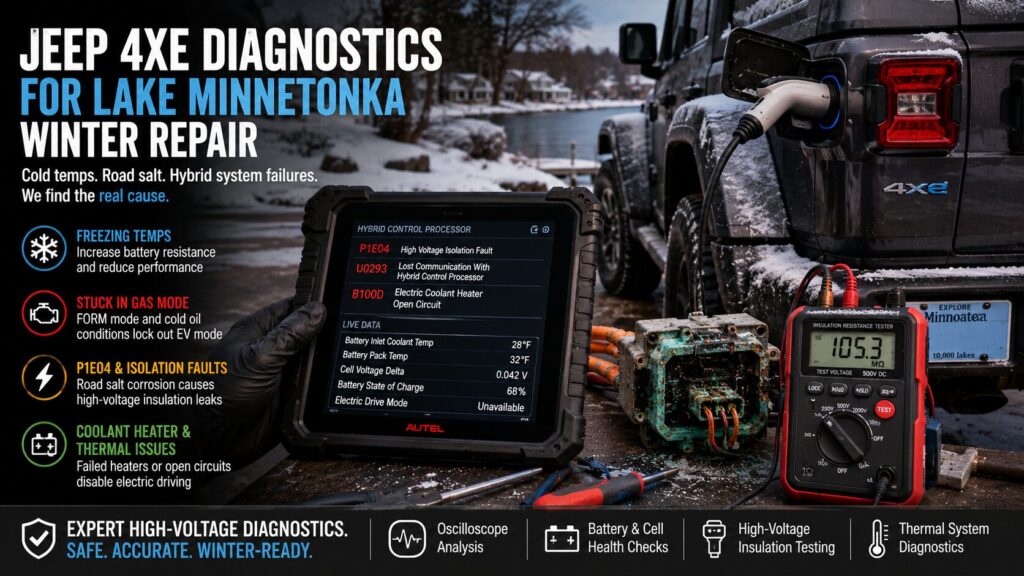
For hybrid owners in the Twin Cities, late winter is often the most brutal stretch of the season. While the calendar hints at spring, the “Electric Mode Unavailable” message persists because the 17.3 kWh lithium-ion battery pack is still fighting sub-zero overnight lows. This condition is not a mechanical breakdown but a deliberate thermal protection strategy used to shield high-voltage cells from freezing temperatures.
FORM Logic on the Shorewood Route
The most frequent culprit for a stuck internal combustion engine on the Shorewood-to-Excelsior route is the automated Fuel and Oil Refresh Mode. During short local trips in freezing air, the 2.0L turbocharged engine rarely reaches full operating temperature. When the engine runs briefly and shuts down, unburnt fuel seeps past the piston rings and contaminates the engine oil.
To prevent catastrophic engine damage, the Hybrid Control Processor forces the gas engine to run continuously to evaporate that fuel. This automated cleaning cycle completely locks out electric vehicle mode until the oil dilution drops to a safe level. Short commutes around the lake prolong this cycle significantly.
Internal Resistance and Thermal Management
The fundamental physics of lithium-ion cells dictates operating performance in extreme environments. In sub-zero temperatures, the internal battery electrolyte loses its fluidity and experiences a gelling effect that hinders chemical ion flow. When attempting to accelerate onto Highway 12, the Power Control Unit instantly detects this high internal resistance.
To prevent permanent thermal shock to the delicate cells, the system restricts maximum regeneration and calls upon the gas engine for torque. This deep freeze effect is especially prevalent in Wayzata when a vehicle sits on a cold concrete slab overnight. It can take nearly an hour of continuous driving for the battery pack to reach its efficient operating temperature of 50°F.
The Electric Coolant Heater Open Circuit Fault
The environmental challenges encountered during winter in Spring Park extend far beyond the thermometer. The electric coolant heater is responsible for warming both the passenger cabin and the high-voltage battery pack. In high-moisture, sub-zero environments, the internal ceramic elements of this heater can experience severe stress fractures.
An open circuit fault inside this heating element will immediately disable electric mode operations. When the component fails to warm the passing coolant, the hybrid processor locks out the battery to prevent permanent chemical degradation from a cold-start discharge. Replacing this module requires full high-voltage system de-energization.
Isolation Resistance and Code P1E04
By the end of winter, local roads are heavily saturated with highly conductive road salt brine. This slush penetrates deep into high-voltage wiring harnesses, creating a microscopic electrical bridge to the vehicle chassis ground. This drop in insulation resistance immediately triggers code P1E04 and illuminates the service hybrid system message.
- Scanner Limitations: Generic retail scan tools completely overlook these critical insulation breaches.
- Specialized Equipment: Diagnosis requires a dedicated megohmmeter to safely inject precise voltage and pinpoint the leak.
- Real-World Experience: In a recent P1E04 case for a Lake Minnetonka driver, our testing revealed the leak was simply salt accumulation on an exterior plug, allowing us to perform a low-cost decontamination instead of a costly part replacement.
- Common Source: The underlying issue is often simple salt accumulation on unshielded exterior plugs rather than a failed battery.
Deep Diagnostic Tracing Inside the HCP
Diagnosing a service hybrid system alert requires looking far deeper than standard powertrain trouble codes. Technicians must access the proprietary data streams within the Hybrid Control Processor and the Auxiliary Control Module. Weak twelve-volt auxiliary batteries frequently drop voltage during startup, tripping false logic codes across the main network.
True hybrid path issues require a forensic analysis of individual cell voltage health metrics. We monitor the individual cell voltage delta during high-load climbs to see if a specific cell group is lagging. Even one weak cell group forces the processor to disable electric mode and rely entirely on the gas engine.
Why Clearing Codes is Not a Solution
Clearing hybrid fault codes with a basic scanner without addressing the underlying data is a major diagnostic mistake. Technicians track live parameter identifiers, such as battery inlet coolant temperature, to see exactly how the cold affects the thermal loops. This live data streaming allows shops to find sticking thermal bypass valves during hot mode transitions.
Moisture and salt air from the ice-out season also cause severe terminal corrosion directly on the J1772 charging port pins. This corrosion disrupts communication with home charging stations, preventing overnight battery pre-conditioning. True resolution relies on physical wiring audits and component isolation rather than software resets.
Expert High-Voltage Diagnostics near Lake Minnetonka
For drivers experiencing persistent hybrid system errors or cold-weather charging failures, systematic network analysis is essential. You can find Certified Auto Repair located at 4700 Shoreline Drive, Spring Park, MN 55384 for comprehensive high-voltage electrical diagnostics.
Frequently Asked Questions
Why won’t my hybrid vehicle go into Electric Mode in cold weather?
Freezing temperatures trigger automated fuel refresh modes or create high internal battery resistance. The hybrid processor forces the gas engine to run continuously to evaporate oil contaminants or protect a gelled battery electrolyte layer. Electric operation remains locked out until the system reaches its designated internal operating temperature.
Does road salt affect the high-voltage hybrid system?
Yes. Road salt aerosol infiltrates exterior high-voltage connectors and drastically reduces insulation resistance over time, which triggers fault code P1E04 and illuminates the service hybrid system warning lamp on the dashboard.
What causes the Service Hybrid System light to illuminate?
This warning indicates a critical high-voltage system fault that requires immediate professional evaluation. In cold climates, it is most often caused by an electric coolant heater failure or salt-induced isolation resistance loss. The control processor hard-locks the system to save the expensive lithium-ion cells from permanent chemical damage.
Can a weak twelve-volt battery stop the hybrid system from starting?
Yes. A weak twelve-volt auxiliary battery will completely prevent the high-voltage contactors from clicking into place. Even if the primary hybrid battery pack is fully charged, the twelve-volt system is required to power the computers and safety relays, and if these relays lack proper voltage, the vehicle cannot initiate its start sequence.
Why does my electric driving range drop so much in late winter?
Range drops due to increased internal cell resistance in the cold and the massive electrical demand of the coolant heater. Freezing air also lowers tire pressures and thickens gear case fluids across the drivetrain. This forces the hybrid system to consume significantly more energy just to move the vehicle down the road.