Freezing Minnesota temperatures and road salt trigger critical Jeep CAN bus communication failures and module ghosting. This technical guide explains how low battery voltage and terminal corrosion disrupt the network. Learn the precise diagnostic steps including resistance checks and oscilloscope analysis required to pinpoint the root cause without swapping parts.
Low Voltage Digital Silence and Cold Weather Stalling
Chemistry dictates that battery capacity drops significantly as the temperature falls during Minnesota winters. I frequently see batteries that tested fine in autumn sag to nine volts during a freezing morning crank. While there might be enough amperage to turn the starter motor, that sudden voltage drop is catastrophic for the sensitive logic gates of the Totally Integrated Power Module.
If the Totally Integrated Power Module or Body Control Module suffers a voltage drop, they often fail their power-on self-test within the required millisecond handshake window. When those specific modules drop off the network, the Jeep enters an unresponsive state of digital silence. You are left staring at a dark dashboard while the starter motor turns the engine over in vain.
Deciphering U-Series Codes and Communication Silence
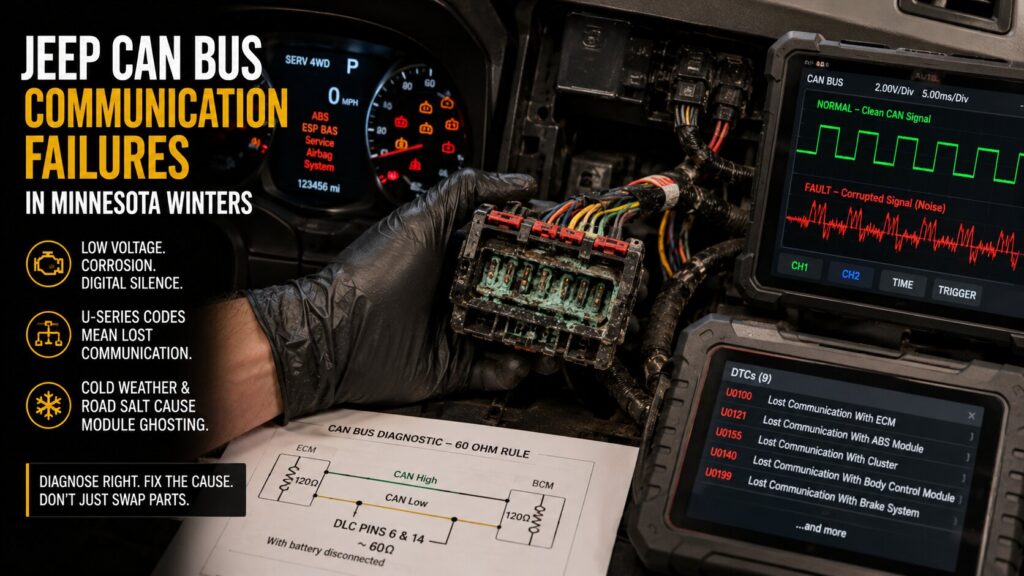
When I plug in my professional scan tool after a breakdown on County Road 19, I am not looking for standard powertrain codes. I am specifically hunting for communication faults like U0100 lost communication with the engine control module or U0121 lost communication with the anti-lock brake module. It is a massive mistake to automatically misdiagnose these codes as a completely dead computer.
In my practical experience, the internal hardware of the module is almost always healthy. The module is simply being drowned out by intense electrical noise on a compromised network. Technicians must avoid immediate parts swapping and focus entirely on locating the source of that communication interference.
The Orono Green Crust and Star Connectors
One of the most common failure points I see in Spring Park involves the connectors located behind the glovebox or in the passenger kick panels. This issue happens frequently on Wrangler JK or JL models and Grand Cherokee WK2 platforms. As you drive through Shorewood, snow and salt accumulate heavily on your winter boots.
As the cabin warms up, that trapped moisture evaporates and creates a high-humidity microclimate behind your interior trim. That salt-laden moisture settles directly on the pins to form what I call the Green Crust of copper acetate. On the Grand Cherokee WK2 especially, this conductive corrosion bridges the CAN High and CAN Low lines to shorten the network.
Master-Level Diagnostics and Fault Isolation
The 60-Ohm Rule Resistance Checks
When I test a healthy Jeep CAN bus network, I always look for a very specific resistance value. With the vehicle battery disconnected, I measure across pins six and fourteen of the Data Link Connector. The standard parallel circuit formula determines our expected target.
1/Rt=1/120+1/120→Rt=60 Ω
- A reading of 120 ohms means a physical break exists in a terminating resistor.
- A reading of zero ohms indicates a direct short circuit somewhere on the network lines.
- A reading between 75 and 90 ohms points to classic high-resistance corrosion interfering with data signals.
Visualizing the Conversation with Oscilloscopes
Jeep CAN bus communication happens via distinct square waves that should look crisp and uniform on a healthy system. When road salt penetrates a wiring harness, it introduces electrical noise that looks like jagged spikes on my screen. This distortion confuses the modules and causes the classic Christmas tree effect where every single dashboard warning light illuminates.
My Verdict as a Master Technician
I will never condemn an expensive Totally Integrated Power Module based solely on a lost communication code. My diagnostic process involves systematically isolating the bus by unplugging individual modules from the Star Connector. I monitor the oscilloscope screen until the specific component screaming noise onto the network line is disconnected.
Frequently, the permanent fix is not a new computer but a simple fifteen-dollar connector cleaning and a weather-sealed wire splice. Original manufacturing specs do not account for the intense chemical warfare we face on Minnesota roads during winter. If your Jeep is ghosting you in the cold, a deep-dive electrical audit is the only logical solution.
Professional Automotive Diagnostic Address
For drivers experiencing these electrical faults, professional troubleshooting prevents unnecessary component replacement. You can find our specialized diagnostic team at Certified Auto Repair located at 4700 Shoreline Drive, Spring Park, Minnesota 55384.
Frequently Asked Questions
Why does my Jeep dashboard light up like a Christmas tree in cold weather?
Freezing temperatures cause battery voltage to drop significantly during a cold startup, which starves the modules of required operating power. The instrument cluster loses its data feed from the anti-lock brakes and airbag modules due to this voltage sag. It defaults to a fail-safe state and illuminates every dashboard warning lamp despite the actual hardware being perfectly intact.
Can road salt cause electrical errors in my Jeep?
Yes, road salt is highly conductive and easily bypasses degraded wiring seals in moisture-heavy environments. When salt-laden moisture settles on the interior Star Connectors, it forms a conductive corrosion layer that bridges the communication lines. This increases electrical resistance or creates a direct short circuit that forces modules to ghost the rest of the network.
What does it mean when a Jeep has a U0100 code?
A U0100 code indicates that the Engine Control Module has lost communication with the other computers on the CAN bus network. In the Shorewood area, this code is frequently caused by a corroded wiring harness or a failing Star Connector rather than a defective engine computer. Resolving this issue requires a systematic electrical trace rather than replacing expensive modules.
Should I replace my Jeep computer if I have communication codes?
No, you should never replace an expensive computer module without a complete diagnostic trace of the network wiring. Most Jeep communication errors in cold climates are caused by external wire corrosion or voltage drops rather than internal hardware failure. A physical inspection of the bus connections prevents you from misdiagnosing a healthy computer.
How do you test for a short in the Jeep CAN bus?
I connect a digital multimeter to the OBD-II port to check for sixty ohms of total network resistance. After that, I use an oscilloscope to watch the shape and clarity of the communication square waves in real time. By systematically disconnecting individual modules from the Star Connector, I can pinpoint the exact branch causing the electrical short.