After a collision or windshield replacement, Jeep Advanced Driver Assistance Systems (ADAS) require precise recalibration. Misaligned cameras and radar sensors can lead to unintended braking or steering failures. This guide explains the technical necessity of professional scan tool diagnostics and physical alignment to restore safety standards for drivers in the Mound area.
The Hidden Complexity of Modern Jeep Safety Systems
For families driving along Sunnyfield Road or dropping students off at Mound Westonka High School, the safety features in a Jeep Grand Cherokee or Wrangler provide significant peace of mind. Modern safety features, such as Lane Keep Assist and Automatic Emergency Braking, depend entirely on a highly sensitive web of radar units and cameras.
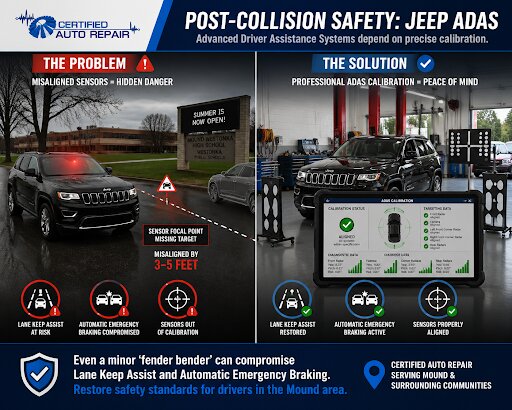
However, even a minor “fender bender” in a school parking lot or a stone chip from Highway 15 is enough to compromise these systems. A sensor shift of even a fraction of a degree can cause its focal point to miss its intended target by several feet at a distance of 100 yards. This discrepancy is why ADAS calibration is no longer optional—it is a functional requirement for vehicle safety.
How Minor Accidents Impact ADAS Sensors
Many drivers assume that if the dashboard isn’t lit up like a Christmas tree, the car is fine. In the world of ADAS, this is a dangerous misconception.
Camera Displacement
The forward-facing camera is typically mounted behind the rearview mirror, pressed against the windshield. Replacing a cracked windshield or enduring a structural impact can significantly alter the camera’s pitch and yaw, disrupting its factory-set alignment. If the camera thinks the lane lines are two feet to the left of where they actually are, the Lane Keep Assist may “incorrectly” steer directly into oncoming traffic.
Radar Misalignment
Jeep ADAS radar sensors are often located in the front grille or lower bumper. These sensors measure the distance and speed of the vehicle in front of you. A minor tap to the bumper might not leave a scratch, but it can bend the mounting bracket. This leads to “radar misalignment”, where the Adaptive Cruise Control fails to detect a stopping vehicle in time.
The Recalibration Process: Static vs. Dynamic
Restoring these systems isn’t as simple as clearing a code. It requires a two-step technical approach:
- Static Calibration: This takes place in a controlled shop environment. We use specialized aiming targets placed at precise distances and heights. The vehicle’s onboard computer is put into a learn mode via a professional-grade scan tool, allowing it to recognize the target and reset its zero point.
- Dynamic Calibration: Some Jeep models require a “test drive”. The technician drives the vehicle at specific speeds on well-marked roads (like the stretches of County Road 110) while the system monitors surrounding landmarks to fine-tune its orientation.
Why a Professional Scan Tool is Mandatory
Standard OBD-II scanners found at parts stores cannot perform ADAS resets. Professional diagnostics are required to:
- Identify DTCs (Diagnostic Trouble Codes): Many ADAS faults are soft codes that don’t trigger a Check Engine light but do disable safety features.
- Validate Alignment: The system must verify that the alignment of the vehicle’s wheels is perfectly aligned with the front sensors. If your wheel alignment is off, your ADAS calibration will never be accurate.
- Update Software: Manufacturers frequently release firmware updates that improve sensor logic in difficult weather conditions, such as the heavy snow and sleet we experience in the Mound area.
Real-World Insight: The Phantom Braking Risk
In our work serving the Mound and Spring Park community, we recently saw a Jeep that had undergone a simple bumper repair at a body shop that didn’t specialize in electronics. The owner noticed the car would occasionally slam on the brakes while driving past parked cars near the high school.
Upon inspection, we found the front radar sensor was tilted downward by only three degrees. The car saw the ground as a solid object and triggered an emergency stop. This highlights the risk of ignoring calibration: the system meant to save you can become the cause of an accident.
Risks of Ignoring Calibration
- Delayed Reaction Times: The system may take an extra second to recognize a hazard.
- Inaccurate Warnings: Constant beeping for non-existent threats leads to driver fatigue, causing many to turn the safety systems off entirely.
- Liability Issues: Operating a vehicle with known ADAS misalignments can lead to significant complications regarding legal liability and the processing of insurance claims following an accident.
When to Evaluate Your Jeep’s ADAS
Consider having your Jeep’s ADAS systems evaluated if:
- You’ve replaced the windshield.
- The vehicle has been in any collision, regardless of visible damage.
- You’ve installed a lift kit or leveled the suspension.
- The steering wheel feels off-center.
At Certified Auto Repair, our ASE-certified technicians use advanced scanning tools to ensure your Jeep’s sensors meet manufacturer standards, preserving the integrity of its safety features. Serving the Lake Minnetonka area, we provide expert ADAS evaluations.
Visit us today at 4700 Shoreline Dr, Spring Park, MN 55384, United States to learn more or schedule a consultation at your convenience.
Frequently Asked Questions
Does my Jeep really need calibration after a simple windshield replacement?
Yes, the camera is mounted directly to or behind the glass, and even a slight difference in glass thickness or mounting position changes the camera’s angle.
Will the car tell me if the sensors are misaligned?
Not always. While a total sensor failure will trigger a warning, a misaligned sensor may continue to operate with degraded accuracy. You might only realize there is an issue when the system fails to react during a critical moment.
How long does an ADAS calibration take?
The total time for an ADAS reset generally spans one to three hours, contingent upon the specific model and the necessity of static or dynamic calibration procedures. This includes the initial diagnostic scan and the final validation drive.
Can I calibrate the sensors myself?
No, calibration requires specific OEM-grade software and precision-engineered targets that must be placed at exact millimeter measurements. Without this equipment, it is impossible to verify the sensor’s accuracy.