Death wobble in Jeep Wranglers is a violent steering oscillation often triggered by road imperfections. In Minnesota, freeze-thaw cycles on routes like MN-15 create potholes that stress aging suspension components. This guide identifies how compromised track bar bushings and misaligned steering geometry trigger violent oscillations. It explains why professional diagnostics are required to isolate mechanical play and restore vehicle stability.
Why the “Death Wobble” Haunts Minnesota Jeep Owners
For Jeep Wrangler owners in the Spring Park and Lake Minnetonka area, the term “Death Wobble” isn’t just a dramatic nickname—it is a startling reality. This phenomenon is a violent, self-sustaining steering oscillation triggered by road impacts at speeds above 45 mph.
In Central Minnesota, our infrastructure faces a brutal cycle. The freeze-thaw cycle, where moisture in the pavement expands during freezing temperatures and contracts as it thaws, damages roads like MN-15. These fluctuations create potholes that exacerbate suspension wear. By the time spring arrives, the transition from smooth asphalt to jagged potholes creates the perfect laboratory for steering failure.
The Physics of the Wobble: How It Starts
The Jeep Wrangler utilizes a solid front axle design. While this is superior for off-road articulation, it means the two front wheels are physically linked. If one wheel reacts violently to a pothole on Shoreline Drive, that energy is transferred directly to the other side.
Under normal conditions, your suspension absorbs road energy. However, when components have even a fraction of an inch of “play,” that energy isn’t absorbed; instead, it resonates. This resonance creates a harmonic oscillation, making the vehicle feel like it’s shaking apart. Increased wear on parts like the track bar and ball joints, compounded by potholes and Minnesota’s freeze-thaw cycles, amplifies the issue.
Common Root Causes Within Suspension Geometry
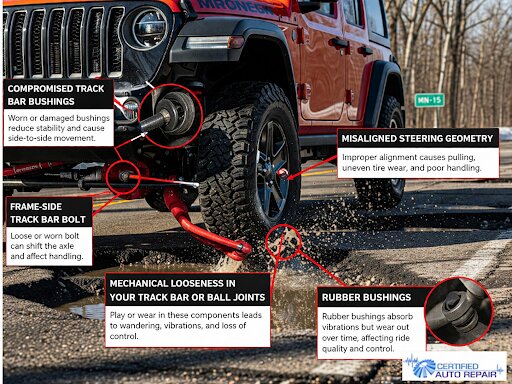
Diagnosis often reveals a convergence of marginal wear across multiple components rather than a single catastrophic part failure.
The Track Bar (The Leading Culprit)
The track bar is the most critical lateral stabilization component. It bolts the axle to the frame. If the bushings at either end are soft or if the mounting bolt hole has become “ovalized” due to vibration, the axle can shift side-to-side independently of the chassis. Potholes along MN-15 exacerbate this issue by creating constant impacts that accelerate wear on the track bar.
Ball Joint Play
Ball joints act as the pivot point for your steering. Minnesota road salt can accelerate the degradation of the protective boots, allowing grit to enter the joint. Once the internal sphere wears down, the knuckle can shimmy, contributing to the oscillation.
Tie Rod and Drag Link Ends
These components transmit your steering input to the wheels. If the rod ends are worn, the wheels can “flutter” back and forth. This issue is made worse in Jeeps running larger-than-stock tires, which place greater leverage on these joints, causing them to wear faster.
Caster Angle and Alignment
If your Jeep is lifted, your caster angle—the forward or backward tilt of the steering axis—may be out of spec. When the steering axis tilt is too shallow, the vehicle loses its directional stability, especially on roads like MN-15, where potholes and frost heaves create uneven surfaces. This lack of lead-in makes the Jeep highly susceptible to resonance on uneven pavement.
Local Case Study: The MN-15 Masked Failure
At our shop, we recently evaluated a Wrangler that experienced a terrifying wobble while commuting toward St. Cloud on MN-15. The driver reported the vehicle felt fine on smooth city streets, but the repetitive rhythmic bumps common on that stretch of highway triggered a loss of control.
Upon inspection, we found that while the steering stabilizer looked new, the frame-side track bar bolt had worked itself loose by just a few millimeters. This is a classic example of a masked issue; a steering stabilizer can often hide worn parts for a few months before a specific road trigger—like a Minnesota frost heave—forces the underlying failure to the surface.
Professional Diagnostic Procedures
A visual “eyeball” test is rarely enough to solve death wobble. Professionals use a specific sequence to isolate the root cause:
- The Dry Park Test: With the engine off and the vehicle’s weight on the tires, one technician turns the steering wheel rapidly back and forth while another crawls underneath to feel for “pops” or movement in the joints.
- Torque Verification: We check every suspension bolt to ensure it meets factory foot-pound specifications. In many cases, a bolt that looks tight is actually under-torqued, exacerbating wear from Minnesota’s rough roads.
- Alignment Rack Analysis: Using precision lasers, we measure the caster and toe-in angles to ensure the geometry isn’t fighting itself.
- Tire Balance and Runout: We check for out-of-round tires or bent wheels, which often act as the initial trigger for the wobble.
Important Note: Replacing the steering stabilizer is a common band-aid fix. While a heavy-duty stabilizer can dampen vibrations, it does not fix the mechanical looseness causing the wobble. Ignoring the root cause can lead to catastrophic failure of the steering box or frame mounts.
Expert Jeep Track Bar and Ball Joint Evaluation
If your vehicle is experiencing steering instability or a full-scale death wobble, a systematic inspection is essential for your safety. At Certified Auto Repair, our ASE-certified technicians specialize in diagnosing the specific failures caused by Minnesota’s unique road conditions. If you’re concerned about your Jeep’s handling on local highways, reach out to us for a professional suspension and steering evaluation.
Visit us today at 4700 Shoreline Dr, Spring Park, MN 55384 for a thorough evaluation and let us restore your Jeep’s performance to ensure your safety on the road.
Frequently Asked Questions
Is it safe to drive with death wobble?
No. While the wobble often stops when you slow down, the violence of the shaking can cause sudden component failure or lead to a loss of steering control. It should be addressed immediately.
Will new tires fix my death wobble?
Rarely. While unbalanced or “out-of-round” tires are a common trigger for the oscillation, they are almost never the root cause. Installing new tires may temporarily mask the symptoms by dampening the vibration, but the underlying mechanical looseness in your track bar or ball joints will remain. .
Does the cold Minnesota winter make death wobble worse?
Yes, indirectly. Extreme cold can make rubber bushings more brittle and less compliant. Furthermore, the potholes created by the spring thaw are the primary triggers that initiate the oscillation.
Why did my Jeep start wobbling after I installed a lift kit?
Incorrect caster angle is the primary cause. Lifting a Jeep changes the front-end geometry, often rotating the axle forward and reducing “positive caster.” This loss of directional stability makes the steering hypersensitive to bumps, allowing a small vibration to escalate into a full death wobble.