Extreme cold and frequent toggling between 4WD and 2WD during Lake Minnetonka winters accelerate wear on Jeep transfer cases. Issues typically stem from fluid contamination, electronic actuator failure, or internal chain stretch. Professional diagnostic inspections and timely fluid services are essential to prevent drivetrain binding and costly mechanical breakdowns.
The Strain of Minnesota Winters on Your Jeep’s Drivetrain
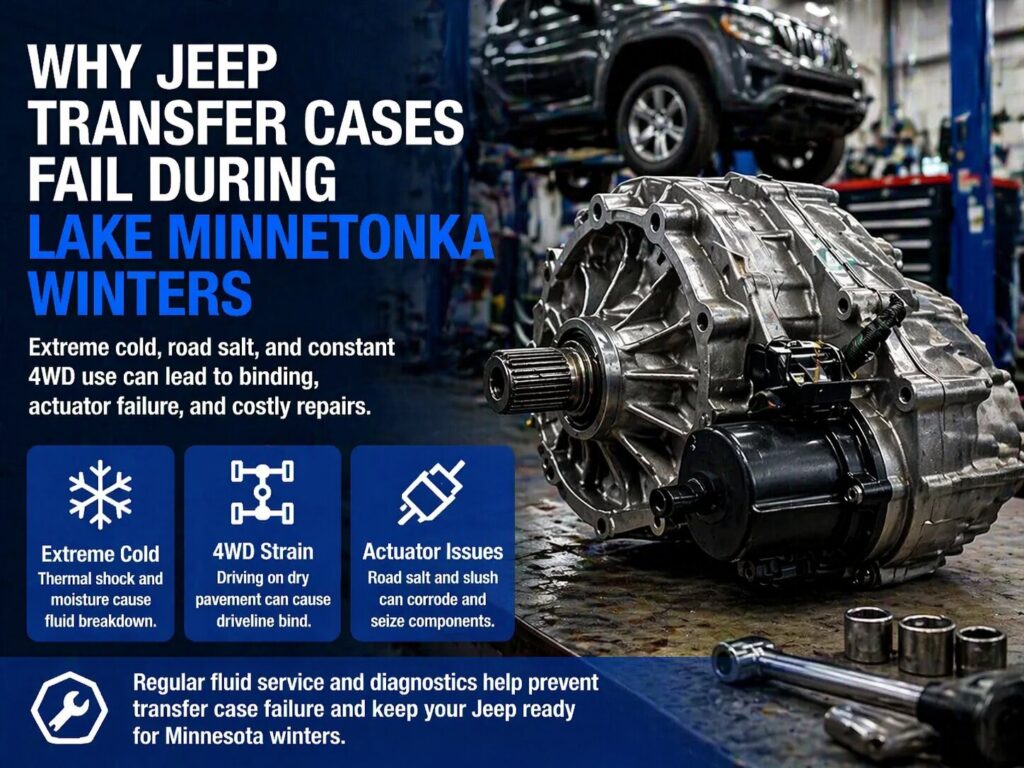
For Jeep owners in Spring Park, Minnetrista, and Mound, the transfer case is the heart of winter capability. It is the component responsible for taking power from the transmission and splitting it between the front and rear axles. When the snow piles up along Highway 15 or the backroads near Lake Minnetonka become a sheet of ice, we rely on that “4-High” engagement to stay on the road.
However, the very conditions that make 4WD necessary also create a perfect storm for transfer case failure. In our shop, we see a significant uptick in drivetrain issues between December and March. This isn’t just a coincidence; it’s a result of thermal shock, moisture, and the mechanical stress of constant shifting.
How the Transfer Case Operates (And Where It Struggles)
Most modern Jeeps (like the Grand Cherokee or Wrangler) use either a chain-driven manual transfer case or an electronically controlled On-Demand system.
- The Chain: A heavy-duty chain transfers power to the front output shaft. Over time, especially with heavy torque loads in deep snow, this chain can stretch.
- The Fluid: Transfer case fluid is specifically formulated to lubricate these moving parts and dissipate heat.
- The Actuator: In electronic systems, a small motor (the actuator) moves the internal fork to engage the gears.
In the Lake Minnetonka area, we often deal with mixed road conditions—patches of clear asphalt followed by deep drifts. Many owners end up keeping their Jeeps locked in 4WD for too long or toggling the selector while moving at high speeds, a habit that spikes internal heat and rapidly thins out the lubricating fluid.
Common Failure Points We See in Spring Park
After years of working on local Jeeps, we’ve pinpointed three main causes for transfer case failure during a typical Minnesota freeze.
Fluid Contamination and Condensation
Temperature swings are brutal here. Your transfer case can go from 0°F sitting overnight to over 200°F during a long commute. This creates condensation inside the case. If the fluid isn’t changed according to the severe weather schedule, that moisture mixes with the oil, reducing its ability to protect the bearings. We often find “milky” fluid in Jeeps that have spent the winter navigating slushy lakeside roads.
Electronic Actuator Failure
The actuator motor is often mounted low on the vehicle and is constantly exposed to road salt, slush, and ice. We frequently encounter cases where the internal electronics of the actuator short out or the motor seizes. When this occurs, your Jeep may become stuck in 4WD—resulting in driveline binding or torque steer during tight turns—or it may fail to engage 4WD when you need it the most.
Driveline Bind on Cleared Roads
This is a common regional issue. A driver engages 4WD to get out of a snowy driveway in Minnetrista, but then drives several miles on salted, dry pavement on the way to the city. Without any slip between the road surfaces, the front and rear axles become misaligned. The resulting torque strain damages the internal chain and planetary gears, often leading to a sharp noise right before the entire assembly experiences a catastrophic failure.
Symptoms vs. Root Causes
It is important to distinguish between a minor sensor glitch and a catastrophic mechanical failure.
- The “Service 4WD” Light: Corrosive road salt frequently eats through the protective loom, leading to a shorted-out wiring harness or a seized encoder motor that triggers the 4WD light.
- Grinding or Popping: This usually indicates a stretched chain skipping over gear teeth. This is a mechanical failure that requires a teardown.
- Fluid Leaks: Often found at the output shaft seals. If the fluid level drops too low, the internal components will overheat and weld themselves together within miles.
Technical Note: If you hear a high-pitched whirring that changes with vehicle speed (not engine speed), it is likely an output shaft bearing inside the transfer case beginning to pit or gall.
Case Study: Lakeside Fluid Contamination
A Jeep from Mound recently presented with driveline vibration during low-speed turns. We drained the unit and found typical fluid contamination, which occurs when deep Lake Minnetonka snow forces water into the transfer case through the vent tube, mixing with the fluid.
Mechanical evaluation revealed gritty resistance in the shift linkage caused by Lake Minnetonka road salt buildup. In this instance, consistent use of 4WD on the cleared sections of Minnetrista roads had also stressed the internal clutch packs. Identifying this contamination early allowed for a corrective fluid flush, preventing the internal gear binding that typically leads to total assembly failure.
Professional Transfer Case Service Checks
If you notice your Jeep hesitating to shift into 4WD or hear unusual noises beneath your seat, it’s essential to have an expert evaluation. At Certified Auto Repair, our ASE-certified technicians use advanced diagnostic tools to assess electronic shift modules and perform fluid service checks, ensuring your vehicle is protected against harsh winter conditions. Whether you’re commuting through Spring Park or navigating the backroads of Minnetrista, a healthy transfer case is critical for handling Minnesota’s challenging winters.
For residents of our lakeside community, feel free to reach out to us today to discuss a preventative service plan tailored to your needs.
Frequently Asked Questions
Is it safe to drive my Jeep on dry pavement in 4WD High?
Generally, no. Unless your Jeep is equipped with a “Full-Time” or “Auto” 4WD setting, driving on dry pavement in 4WD causes “driveline bind.” This puts excessive stress on the transfer case and can lead to broken gears or a stretched chain.
How often should I change my transfer case fluid in Minnesota?
While many manuals suggest long intervals, our local conditions qualify as “Severe Service.” We recommend checking the fluid annually and replacing it every 30,000 miles to remove the moisture and metal shavings common in our climate.
What does it mean if my Jeep is “hopping” during tight turns?
This usually means your transfer case is stuck in 4WD or your lockers are engaged. On dry pavement, the wheels need to spin at different speeds during a turn; if the transfer case forces them to spin at the same speed, the tires will “hop” or scuff.
Can road salt actually break my 4WD system?
Indirectly, yes. Road salt is highly corrosive to the electrical connectors and the aluminum housing of the transfer case. It often causes the 4WD actuator motor to seize or the wiring to corrode, leading to electronic failures.
Proactive Drivetrain Care
The transfer case is a rugged piece of machinery, but it isn’t invincible. The combination of sub-zero temperatures and the high-torque demands of navigating Lake Minnetonka snowbanks requires a proactive approach. Catching leaks early, keeping an eye on the road before shifting into 4WD, and sticking to a fluid schedule is the best way to dodge the massive bill for a full drivetrain overhaul.