Engine hose service prevents catastrophic overheating, fluid loss, and vacuum leaks caused by the degradation of rubber components. In Spring Park, Minnesota, extreme temperature swings accelerate hose wear. Timely inspections identify softening or brittleness before a hose bursts, protecting the engine’s internal components from expensive, heat-related structural failure.
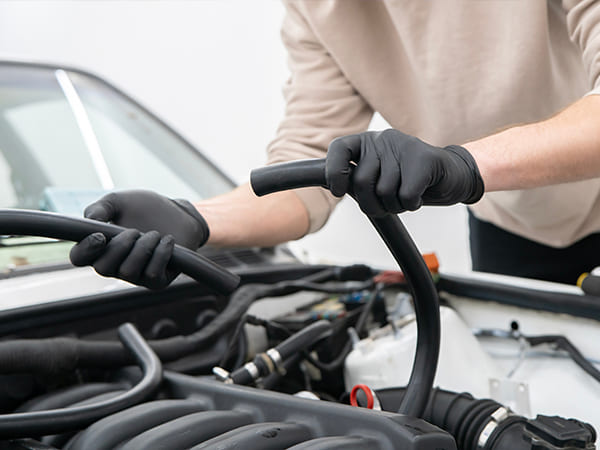
Why Engine Hose Health Matters in Minnesota
In the automotive world, hoses are the circulatory system of your vehicle. They carry coolant to keep the engine from melting down, provide vacuum pressure for braking and emissions, and transport fuel. While metal components in an engine can last decades, the rubber and silicone used in hoses are “wear items” with a finite lifespan.
In Spring Park, MN, our vehicles face a unique challenge: the “thermal seesaw.” We oscillate between sub-zero winters and humid 90-degree summers. This constant expansion and contraction of rubber materials leads to premature hardening and “electrochemical degradation” (ECD). ECD is a process where the hose acts as a conductor between different metals in the cooling system, causing the rubber to crack from the inside out.
What Does Engine Hose Service Actually Prevent?
The primary goal of a professional hose inspection and service is to prevent unplanned downtime and engine damage. When a hose fails, it usually happens under pressure—meaning when you are driving.
Severe Engine Overheating
The most common hose failure involves the upper or lower radiator hoses. If a radiator hose bursts while you are cruising down Highway 15, your engine loses its entire supply of coolant in seconds. Without coolant, cylinder heads can warp, and head gaskets can fail. What could have been a simple hose replacement often turns into a multi-thousand-dollar engine rebuild.
Loss of Power Steering or Braking Assist
Many vehicles utilize vacuum hoses or high-pressure hydraulic hoses for critical safety systems. A leaking vacuum hose can cause a rough idle or a “stalling” sensation, while a failed power steering hose can make the vehicle incredibly difficult to maneuver, especially in tight parking situations near Lake Minnetonka.
Stranded Situations
In our region, a breakdown isn’t just an inconvenience; in January, it can be a safety risk. Preventing a “blown hose” means you aren’t stuck on the side of the road in freezing temperatures waiting for a tow truck.
Evaluating Engine Hoses in Spring Park: Symptoms vs. Reality
To the untrained eye, a hose might look fine because the exterior is clean. However, professional technicians look for specific physical indicators—often invisible from above the engine bay—that a hose is nearing the end of its reliable life.
- The “Squeeze Test”: A healthy hose should feel firm but pliable. If a hose feels “crunchy” or excessively soft and spongy, the internal reinforcement layers have broken down.
- Visual Bulges: Any swelling near the hose clamps indicates that the internal pressure is starting to overcome the structural integrity of the rubber.
- Parallel Cracking: Small cracks at the bends of the hose (often called ozone cracking) are a sign that the rubber has lost its elasticity and is ready to snap.
What We Commonly See in Spring Park
We often see “pinhole” leaks caused by salt and road brine used on Minnesota roads during the winter. This salt can get trapped against the hose near the clamps, leading to corrosion of the metal neck and eventual failure of the hose seal. We recently assisted a local driver whose vehicle was intermittently overheating. While the hose looked okay from the top, the underside had been rubbed raw by a vibrating plastic shroud—a “hidden” failure point that only a lift-based inspection would reveal.
Common Misconceptions About Hoses
A frequent mistake is assuming that low mileage means the hoses are safe. Rubber degrades based on age and environment just as much as mileage. A ten-year-old car with only 40,000 miles is often at higher risk for a hose burst than a three-year-old car with 60,000 miles because the rubber has had more time to dry out and lose its plasticizers.
Another misconception is that “stop-leak” fluids can fix a leaking hose. These products are designed for radiators, not rubber. Using them to try and “plug” a hose leak is ineffective and often clogs the heater core, leading to a loss of cabin heat—something no one in Spring Park wants to deal with during a cold snap.
Local Insight: The “Hidden Leak” on Shoreline Drive
In the Spring Park area, engine hose issues don’t always start with a puddle. We recently assisted a driver who noticed a faint, sweet smell after commuting along Shoreline Drive. While no leaks were visible on the ground, a pressurized inspection revealed a pinhole leak on the underside of a heater hose. The coolant was evaporating off the hot engine block before it could drip, masking a failure that would have eventually led to a total breakdown on a busy local road.
Professional Evaluation vs. DIY
While a car owner can certainly look for major leaks, many hoses are tucked deep within the engine bay, hidden under intake manifolds or near the firewall. Professional technicians use pressure testers to pressurize the cooling system while the engine is cold. This allows us to find “weeping” leaks that only occur when the system is under load, without the risk of the owner burning themselves on a hot engine.
Professional Confirmation in Spring Park
If you are concerned about the age of your vehicle’s cooling system or have noticed a faint, syrupy scent after a drive through Spring Park, a professional evaluation can provide the clarity you need. Whether you are prepping for a cross-state trip or just want to ensure your car is ready for the next Minnesota cold snap, the team at Certified Auto Repair is here to help. Reach out to us for a thorough inspection to keep your vehicle reliable and your commutes around the lake worry-free.
Frequently Asked Questions
How often should I have my engine hoses inspected in Minnesota?
We recommend a visual inspection at every oil change, with a more thorough “squeeze test” and pressure check every fall before the extreme cold sets in.
Does the extreme cold in Spring Park make hoses more likely to break?
Yes. Cold temperatures make old, hardened rubber brittle. When you start a frozen engine and hot coolant suddenly rushes through a brittle hose, the thermal shock can cause it to crack or split.
If one hose fails, should I replace them all?
Generally, yes. Hoses are manufactured as a set and exposed to the same conditions. If the upper radiator hose has failed due to age, the lower hose and heater hoses are likely in a similar state of decay.
What is the “sweet smell” coming from my engine bay?
That is typically the scent of ethylene glycol (coolant). If you smell something sweet like maple syrup after driving, it is a strong indicator that a hose is weeping fluid onto a hot engine component.
The Proactive Approach
Engine hose service is one of the most cost-effective forms of preventative maintenance available. By identifying a $150 hose issue today, you avoid a $5,000 engine replacement tomorrow. In a climate as demanding as ours, staying ahead of rubber degradation is the best way to ensure your vehicle starts—and stays running—no matter what the Minnesota weather throws at it.
About the Author
Mark Pfleghaar is the owner of Certified Auto Repair in Spring Park, MN, and a state-licensed Emissions Testing and Repair Technician. Since 1993, he has served the Lake Minnetonka area with a commitment to continuous improvement in diagnostic precision and repair quality.