Bouncy ride? Sudden pulling? Clunks over every pothole? When your Toyota starts acting up, it’s often the suspension trying to tell you something. And here in Spring Park, MN, our rough winters and freeze–thaw cycles make those issues show up even sooner.
AAA reports that potholes cost drivers around $3 billion every year, much of it from suspension and wheel damage that began as small, easy-to-miss warning signs. In this article, you’ll learn how to spot those early clues, understand what they mean, and get a clearer picture of diagnosing Toyota suspension problems before they turn into bigger repairs.
How Your Toyota’s Suspension Keeps You Safe on the Road
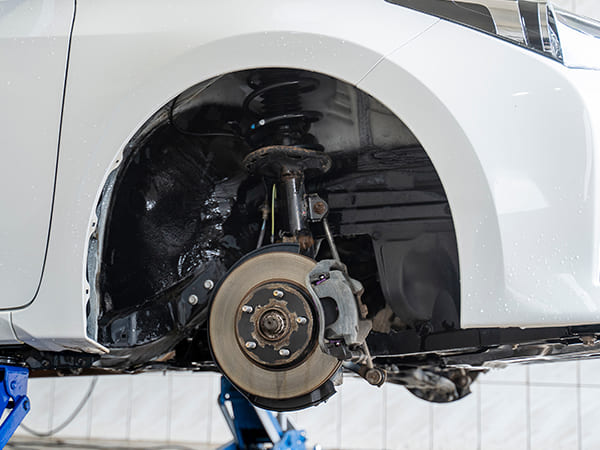
Your Toyota’s suspension is a team of parts—springs, shocks, struts, control arms, ball joints, and more—all working together to keep your ride stable and comfortable. When everything is healthy, your tires stay planted, your steering feels predictable, and bumps don’t shake the whole cabin.
Organizations such as the Car Care Council recommend routine suspension checks because even minor wear can affect how safely your Toyota handles. So when you’re diagnosing Toyota suspension problems, you’re simply confirming that each part is still doing its job and supporting the rest of the system.
2-Minute Driveway Test: Are You Dealing with a Suspension Problem?
Use this quick self-check to start diagnosing Toyota suspension problems at home before you book a shop visit.
1. Visual & Bounce Check
- Park on flat ground in good light.
- Step back and look at the car from the front:
- Does one corner sit lower?
- Does one corner sit lower?
- Press down firmly on each corner and let go:
- Normal: Bounces up, then settles within 1–2 rebounds.
- Problem: Keeps bouncing 3+ times ⇒ worn shocks/struts likely.
2. Short Test Drive Route Idea
Try a loop that includes:
- A smooth section of Shoreline Drive (CR 15)
- A rougher side street with manhole covers or patches
Pay attention to:
- Pulling to one side when braking
- Clunks or metal-on-metal knocks over bumps
- Steering wheel vibration at 35–55 mph
3. Simple Symptom Table (Toyota-Specific Clues)
| Symptom you notice | Likely area to check first | Quick DIY check you can safely do |
| Car pulls left/right on Shoreline Drive | Alignment, tie rods, control arms | Look for uneven tire wear; steering wheel off-center while driving straight |
| Banging or clunking over Mound/Spring Park potholes | Sway bar links, strut mounts, ball joints | Listen for noise when driving slowly over a speed bump |
| Steering wheel shimmy at 45–60 mph | Bent wheel, tire balance, worn struts | Inspect wheels/tires for visible bends or bubbles |
| Front end “diving” hard when braking | Front struts/shocks, control arm bushings | Bounce test on front corners |
| Rear feels loose or “wiggly” in curves | Rear shocks, bushings, sway bar | Bounce test at rear corners; look for fluid leaks on shocks |
If you’re checking multiple items from this table, it’s a strong sign you should get a professional inspection.
Mechanic-Style Walkthrough: How Pros Diagnose Toyota Suspension Issues
When a Toyota comes into a professional shop near Spring Park for diagnosing Toyota suspension problems, techs usually follow a sequence like this:
Step 1: Road Test
- Drive on both smooth and rough roads.
- Listen for specific noises (clunk, creak, rattle, hum).
- Note steering pull, body roll, and braking behavior.
Mechanic tip: A single sharp clunk over bumps often points to a loose sway bar link or worn strut mount. A constant rattling may be exhaust heat shields or loose interior parts instead.
Step 2: Steering & Suspension Shake-down
With the vehicle lifted:
- Grab each tire at 12 & 6 o’clock:
- Play here may mean ball joints or wheel bearings.
- Play here may mean ball joints or wheel bearings.
- Grab at 3 & 9 o’clock:
- Movement often points to tie rod or steering rack wear.
- Movement often points to tie rod or steering rack wear.
- Inspect:
- Cracked bushings
- Leaking shocks/struts
- Torn CV boots
- Rusted or cracked control arms
Professional shops use this physical inspection plus experience with common Toyota patterns (like certain model years wearing specific bushings faster).
Step 3: Alignment & Measurements
If tire wear is uneven or the car drifts:
- The shop will put your Toyota on an alignment rack.
- They compare camber, caster, and toe settings to factory specs.
- On modern Toyotas, a computerized alignment plus a steering angle sensor reset is often required for proper stability-control operation.
Local Scenario: A Spring Park Toyota Owner’s Suspension Wake-Up Call
Picture this:
You drive a Toyota RAV4 that’s done several winters on County Road 15. Lately, you’ve noticed:
- A dull thud over every patched section of pavement
- Slight pulling right on Shoreline Drive
- Front tires wearing more on the inside edges
A shop performs a check and finds:
- Worn front struts with visible fluid seepage
- Cracked lower control arm bushings
- Toe angle out of spec, causing the tire wear
After replacing the worn parts and performing an alignment:
- The steering feels centered again.
- The clunk disappears over rough sections.
- Future tire wear is expected to be normal, extending tire life.
This is exactly what a solid local shop is aiming for when diagnosing Toyota suspension problems in Spring Park—restoring safety, comfort, and consistency.
Quick Reference: Warning Signs vs. “Drive Now, Check Soon”
Use this table as a mini game for yourself:
For each symptom, rate it Green (OK for now), Yellow (schedule soon), or Red (get checked ASAP).
| Symptom | Risk Level (Green/Yellow/Red) | Why it matters locally |
| Slight extra body roll in corners | Yellow | Could worsen quickly with pothole hits in spring |
| Light, occasional clunk on big bumps | Yellow | Often worn link or mount; may become unsafe if ignored |
| Vehicle pulling, steering wheel off-center | Red | Affects control on icy/ slushy roads |
| Loud banging, car feels unstable at speed | Red | Possible major suspension or steering failure risk |
| One side sitting noticeably lower | Red | Broken spring or failed strut possible |
If you have any Red symptoms, treat it as a prompt to book an inspection soon.
Your Next Step for Toyota Suspension Help in Spring Park
In a climate where winter and spring are tough on roads, diagnosing Toyota suspension problems isn’t something to put off. Paying attention to:
- Bounces, clunks, and pulls
- Uneven tire wear
- How your Toyota feels on Shoreline Drive and nearby streets
can help you catch issues early and keep your vehicle behaving the way Toyota designed it.
If you’re in or near Spring Park, MN and want a professional eye on your Toyota’s suspension, Certified Auto Repair on Shoreline Drive offers suspension, shocks, and struts services, along with wheel alignment and full steering inspections. Scheduling a suspension check and alignment is a straightforward way to keep your daily drives around Lake Minnetonka more comfortable and controlled.
FAQs
How often should I have my Toyota’s suspension inspected in Minnesota?
Aim for a steering and suspension inspection at least once a year or every 12,000 miles, with more frequent checks if you often drive rough or pothole-filled roads around Spring Park.
Are pothole hits always bad for my Toyota’s suspension?
A single pothole may not always cause damage, but repeated or severe impacts can quickly wear out suspension parts and should prompt an inspection if new symptoms appear.
Can I drive if my Toyota makes a clunk over bumps but still feels “okay”?
You can typically drive short distances with a clunk, but the noise signals a worn or loose component that should be inspected soon for safety.
Does a suspension problem always require replacing shocks or struts?
Suspension issues don’t always require replacing shocks or struts, since problems can also come from bushings, sway bar links, or alignment.
How do I know if my Toyota needs an alignment or deeper suspension work?
Off-center steering or drifting often points to an alignment need, while added bouncing, noise, or uneven ride height suggests deeper suspension work is required.